Ok... I've made some progress today.
I finally managed to sneeze some of the iron filings out of my nose!

Despite my best efforts at hand and face washing, though, I"m afraid my wife will discover that I've ruined the downstairs bathroom hand towel with black stuff that didn't come free with hand cleaner, soap and water.
I tossed it in the laundry... maybe it'll come clean and she'll never know.
Today, I committed to an engine position.
This has been a really big deal for a number of reasons.
First off, the tranny and the transfer case are really long, so the farther forward I go with engine/tranny/transfer case, the more room I have for a rear drive shaft. Also, if I'm not careful, the shifters are going to end up behind the driver's seat.
Unfortunately, too far forward, and there's no room for a radiator.
I bought a radiator that "goes" with the LS1 in the Chevy Camaro and Pontiac Firebird, but I'm having second thoughts about using it. That it's too wide, I can work with... that it's too TALL is going to be a bigger problem. If I fab notches in the frame deep enough to seat it FULLY behind the radiator panel, then it will basically be all the way through the front frame rail. I'm probably going to go cutsom on the radiator.
This means I have no idea how much room I need in front of the engine! I gave it as much as I could and said, "screw it... it's time to mount the engine."
This morning, I stitch welded together the halves of the riveted frame rails. The outer wall C-channel material is 3/16" and the inner wall C-channel material is 1/8" and fits inside the outer. Rivets on top and bottom fix them together. I wanted better distribution of support so I ran beads along the edges.
Although I had carefully wire-wheeled all the paint off of the OUTSIDE where I was going to weld, there was no way I could get between the plates and clear out the groove. I just had to suck that part up. Most of the welds went just fine, but occassionally I'd get into some snap crackle and pop that would splash weld metal back on me. OUCH!! When I flipped up my hood, I found that there were flames eminating from the groove ahead of my weld and dense gray smoke filled the garage.
I'm pretty sure I just carved about 2 years off the end of my life.
I looked over my work... some of it was ok, some of it was a little on the snotty looking side... overall not my best but plenty servicable. It was HARD to do the out-of-position welds on the BOTTOM edge of the frame.
Here was my nicest looking weld of the day:
Once done with stitch-welds, I proceeded on to the engine mounting project. I jockeyed the engine back and forth with the tape measure out, numerous times. I started to realize that I had NO FIRM GRASP on what straight, square or plumb meant in reference to the frame! I measured from the frame to the garage floor in several places and was reassured that the frame ran reasonably parallel to the floor as a starting point (plus or minus about a 1/16", actually... and within the warpage of the edges of the beaten, riveted, welded metal). I dropped a level on it and it was pretty close, side to side (bubble between the lines everywhere and centering it perfectly required less than an 1/8" of shimming everywhere I checked. That meant I could use the garage FLOOR as a measuring point.
I decided to fix the mounting points at a height relative to the ground. Since the frame was really really close to flat, the engine would be really really close to correctly aligned to the frame. I used the front cross member as a longitudinal reference point and picked a spot 18.5" back from there to mount to the frame. I marked the spots on both sides with a Sharpie pen and then used every T-square type tool I had to verify that the points where dead-on across from eachother and square to the frame. LUCKY for me, the frame rails run parallel through where the engine is supposed to be, while they flare out after that at some bastard angle that I have yet to determine.
My original plan had been to overlay a plate of 3/16" material over the inside aspect of the frame on both sides, where the mounts were going to lock in.
However, silly me... I made my MOUNTS TOO LONG for that! :mofo:
I had measured the space between the frame rails and I had worried that my welds might be less than perfect. I reasoned that the mounts that went on the engine would be largely put in tension and compression (relatively gentle forces on welds) while the mounting tabs on the frame would be placed in shear (a much more aggressive way to product-test the weld!). Therefore, I wanted to have the SHORTEST LEVER on the weld being put in shear and the longer lever could be given to the tension/compression part. I made the engine mounts long enough to get "close" to the frame rails so that my mounting tabs wouldn't have to stick out very far.
I got *REAL* close!
If the overall space between the frame rails is about 24.5" ... the width of my assembled engine+mounts is 24 and a quarter! There's no better than 1/8" clearance on either side.
Great! ... nice short tabs!
However, now I can't box in that part of the frame with 3/16" material to accept the engine mounts!
D'OH!
My choices, as I saw them, were:
1) scrap the mounts, modify or make new ones (fat chance!)
2) weld the tabs directly to the 1/8" inner wall material (yeahright!!)
3) use a gusset with a notch to accept the mount (too much fab work)
4) just cut out the inner wall and replace it with 3/16" mounted FLUSH.
Number 4 seemed the most plausible to me, plus I could use the plasma cutter some more!
I chose a segment of the inner wall of the frame which included 3 of the pre-existing cut-outs and I fashioned a mock up plate out of cardboard. As I did, I realized that had I not gone with this technique, I'd have been welding the 3/16" material ON TO the 1/8" material. I wouldn't have been able to weld it to the stronger stuff on the OUTSIDE of the frame, because the inner wall bulges too much (no - not like the FJC aprons ... it's just made that way).
I cut out the shape on both sides of the frame and then shaped two plates to fit inside. With a whole lot of cutting and grinding, they eventually inset nicely and sat flush. I tacked them down and welded them in place.
I brought the engine back in and repositioned it, only to find that I had wire-wheeled my marking points off when I cleaned up my welds!
D'OH! :cowsmile:
After figuring it ALL out again, I got the engine back into its intended position.
After reading as much as I could and calling a few people who know things not in books, I determined that the LS1 engine does NOT need to be mounted at an angle, although it will tolerate one. Some engines apparently benefit from a down-slant in order to get the oil sump to drain TOWARD the pump mechanism.
I figured that this engine is going to spend a LOT of time at odd angles anyhow, so that part doesn't matter.
What matters is that I'm battling with a really short rear driveline and the more pre-angle I can put on it, the less the CV joint will have to suffer through... but the more I down-angle it at the front, the lower the transfer case will end up being at the other end!
So I gave it a hair of down tilt, just for fun. I can't measure the angle with my tools, but I can guestimate by trigonometry and a bubble level that it's about TAN(0.125/19.5)=1.1 degrees.
Unfortunately, the front end of the frame RISES UP AND OVER the front axle. This isn't a flaw, but it is a challenge when I'm trying to figure out where and how to mount the tabs which will accept the engine mounts! Given where the engine ended up, the mounting had to be different in the front and back on each side.
I had bought a stack of 4 pre-made tabs when i was at 4 Wheeler's Supply (I also saw that they've premanufactured another bracket I'll need when it comes time for my disc brake conversion in the rear end! ... that's for later.) I had hoped that having premade tabs would save me some time. It did, but not much in the larger scheme of things.
Finalizing the tabs took a bit more effort, and then I tacked them in place using the engine and it's mounts hanging from the cherry picker as a template. I lifted the engine back out, tapped the tabs square to the frame with a hammer, and finalized the welds.
Here's what it looks like with my inset reinforcing panel and the mounting tabs in place:
Here's how the engine mounts go on the side of the V-8 engine block. Notice the black urethane insert that should let it wiggle a little:
Then I jockeyed the engine back in place and stabbed the bolt on the driver's side:
Unfortunately, the other side doesn't stab so cleanly. I could crush the frame together with a come-along and MAKE it stab, but that's the WRONG ANSWER! I don't want this under tension ALL THE time. I'm going to ream the 1/2" holes with a 9/16" bit and if it looks like I need more, I'll mount with washers between the fastener and the tab.
I'm not too worried about that since the ENGINE doesn't actually pull the car forward, it just TWISTS in place. The grade-8 bolt in the hole will only see shear force... no "out-pull" tension. If it did, I might worry about having a washer resisting the force.
I'm beat.
I was going to go back down there and assemble the clutch tonight, but I think I'll do that first thing in the morning!
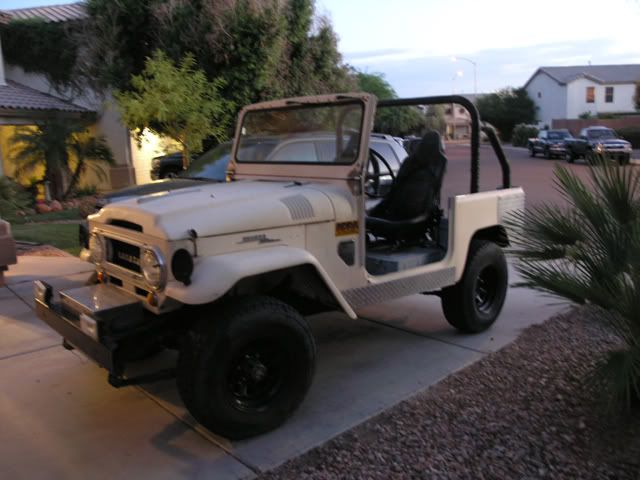
Here's my FJC supervising my engine alignment: